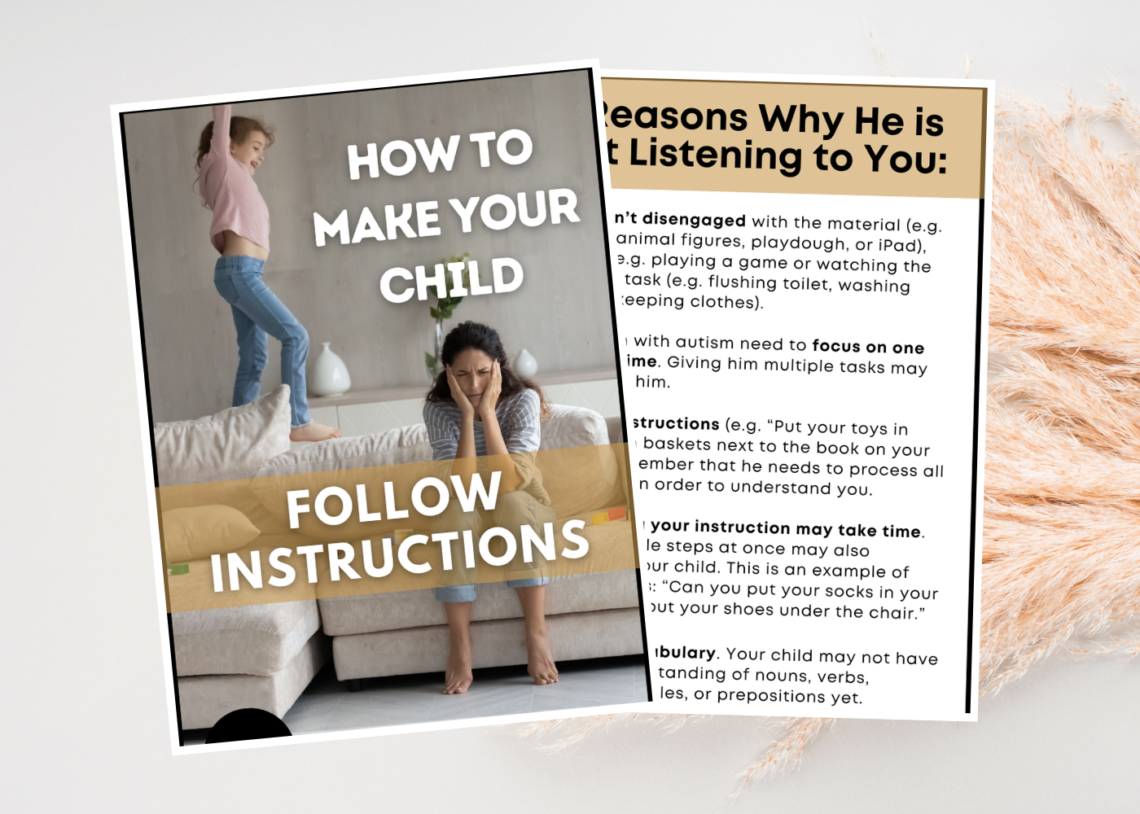
How To Make Your Child Follow Instructions
Written By Quennie Lim
Do you feel like your child does not listen even when you repeat yourself again and again?
Do you sometimes feel frustrated and wonder if your child is ignoring you?
You are not alone. Many parents go through this same challenge every day. The good news is that there are reasons behind it, and there are ways you can help your child improve.
Why Your Child May Not Be Following Instructions
Understanding the reason behind the behavior is the first step in helping your child.
1. Difficulty stopping an activity
Your child may still be focused on something else such as toys, games, videos, or another task. He may not yet be ready to shift his attention to you.
2. Feeling overwhelmed by too many tasks
Children with autism often do better when they focus on one task at a time. Giving several instructions all at once may feel overwhelming and confusing.
3. Instructions are too wordy
Long instructions can be hard to process.
For example: “Put your toys in those green baskets next to the book on your right.”
That sentence may sound simple to an adult, but for a child, it can be confusing. Your child may wonder:
- Which toys?
- Which basket?
- What does “next to” mean?
- Which side is right?
Even adults can get confused by too many details. Imagine how much harder it can be for a child with autism.
4. Your child needs more processing time
Your child may understand what you said, but he may need extra time to think about it and respond.
5. Limited vocabulary or language understanding
Your child may still be learning important words such as action words, names of objects, directions, and sentence structure. If he does not fully understand the words, it will be harder for him to follow the instruction.
Other reasons may include sensory overload, distractions, hunger, tiredness, or difficulty understanding language.
Remember, communication challenges are a major part of autism. When we help a child understand language better, we also help improve listening and following directions.
5 Ways to Help Your Child Follow Instructions
1. Use visual supports
This is one of the best strategies you can use. Many children with autism learn best through visual support because it helps them clearly see what is expected.
Examples of visual supports include picture cards, schedules, First-Then boards, and visual cues for routines.
2. Teach your child every day
Spend 15 to 30 minutes each day teaching your child simple tasks. Even one short activity each day can help build listening and learning skills.
You can practice with puzzles, matching games, file folder activities, or simple home routines.
3. Start with simple instructions before giving multiple steps
Begin with one-word or one-step instructions such as:
- Sit
- Give
- Take
- Keep
Once your child understands these, you can slowly expand to:
- Sit down
- Give me
- Take cup
- Keep toys
Only move to longer instructions when your child is ready.
4. Give processing time
After giving an instruction, wait before repeating it or reacting. Give your child at least 5 to 7 seconds to process your words and respond.
This extra time can make a big difference.
5. Prepare your child before giving the instruction
Help your child transition out of an activity before expecting him to follow the next instruction.
For example, you can say:
“Brian, we will sleep soon.”
“We are going to stop playing soon.”
Repeat this a few times to prepare him. Then say:
“I am going to count to 10 now. Time to stop.”
Once your child has stopped and disengaged from the activity, give the next instruction:
“Brush teeth now.”
This makes it easier for your child to shift from one task to another.
Keep Your Words Consistent
Try not to change your instruction words every day. Use the same simple words again and again so your child can become familiar with them.
Once your child begins to follow the instruction more consistently, you can slowly add new words or another step.
Know Your Child’s Language Level
It is important to understand your child’s current language and communication level. Talk to your child’s Speech Therapist to learn about his strengths and areas of need.
This will help you know what words, sentence structures, and skills to teach at home.
Learn More
To learn more about autism, check out my e-book about “8 Things You Need to Know Before Teaching Your Child with Autism.”
I hope you learned something helpful today.
’Til next time!


You May Also Like
Is There Something Wrong If My Child Has Autism
How Autism Affects Communication