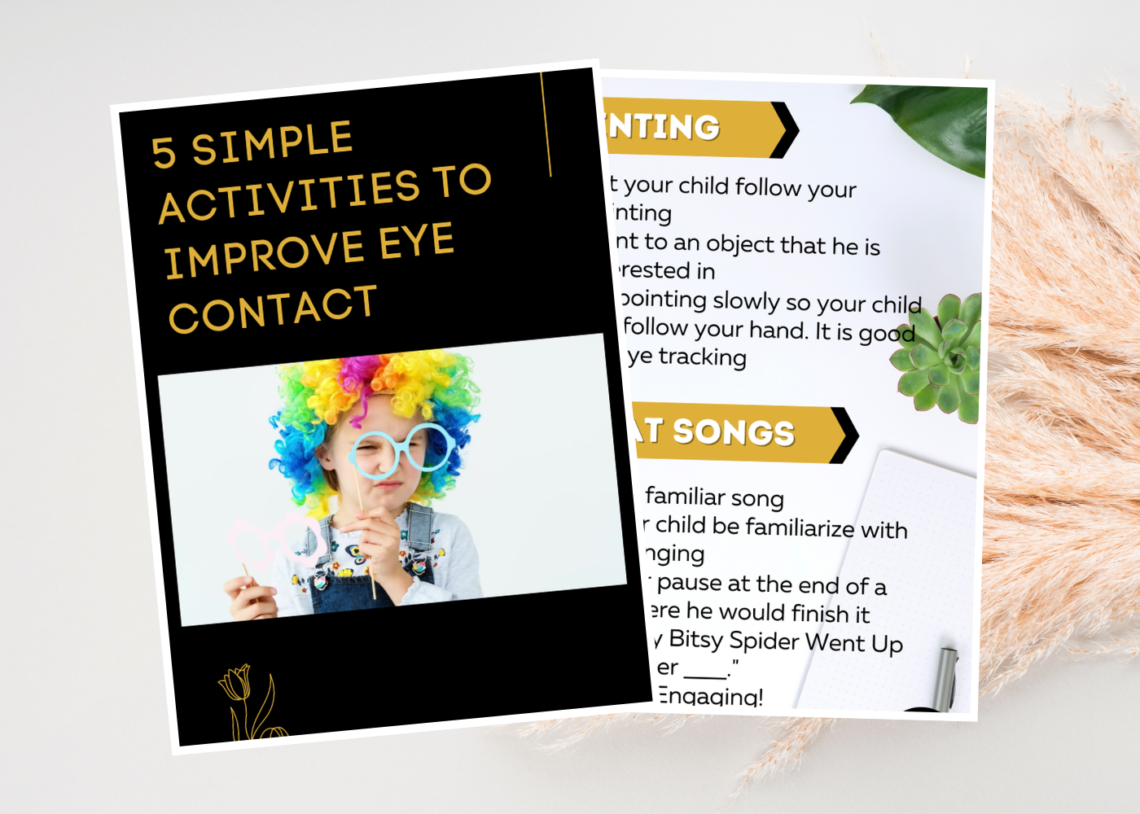
5 Simple Activities to Improve Eye Contact
Written By Quennie Lim
Here are 5 Simple Activities to Help Improve Your Child’s Eye Contact
Gentle, practical ways to build connection, attention, and interaction at home.
Do you find it hard when your child doesn’t look at you while you’re talking or playing? You’re not alone—and more importantly, there is nothing wrong with your child.
Eye contact can be challenging for many children with autism. For some, looking into someone’s eyes can feel overwhelming or uncomfortable.
The good news is that eye contact can be gently developed over time with patience, understanding, and the right strategies.
Here are 5 simple, practical activities you can start using at home.
1. Slow Pointing
Start by placing a favorite toy or object a short distance away. Get down to your child’s eye level, slowly point to the object, and make your face expressive and interesting.
The goal is not eye contact right away. The goal is helping your child learn to follow your pointing and attention.
- Use toys, snacks, puzzles, or anything your child enjoys
- Keep it simple and playful
- Do not force it
Small steps lead to bigger progress.
2. Use Songs with Pauses
Children love repetition, and songs are powerful tools for interaction.
Choose a familiar song your child enjoys, such as Wheels on the Bus, Incy Wincy Spider, or One Little Finger.
Sing the song, then pause right before an expected word. Look at your child and wait. If your child looks at you, even briefly, continue the song.
This helps build:
- anticipation
- interaction
- natural eye contact
Keep it fun, relaxed, and part of your daily routine.
3. Play “Ready, Set… Go!”
This is simple and effective.
Say, “Ready… Set…” and pause before saying “Go!” Wait a moment and see if your child looks at you.
When your child looks, say “Go!” with excitement.
Over time, this teaches:
- turn-taking
- attention
- eye contact through play
4. Exaggerate Your Expressions
Children with autism may have difficulty reading facial expressions, so make your emotions easier to see.
- Big smiles
- Wide eyes
- Playful surprise
- Clear happy, sad, or excited faces
The clearer your expression, the easier it is for your child to notice and understand it.
You are not just building eye contact—you are also building connection and emotional understanding.
5. Stay at Eye Level
Sometimes eye contact is difficult simply because of positioning.
- Bend down to your child’s level
- Sit or lie beside them during play
- Bring your face closer during daily routines
When your face is easier to see, eye contact becomes more natural. Even looking toward your face is already a meaningful step forward.
A Gentle Reminder for Parents
This is not a quick fix, and that is okay.
Every child is different. Some children may take longer, while others may respond more quickly. What matters most is consistency, patience, and making learning feel safe and enjoyable.
Progress happens in small moments. Celebrate them.
Final Thought
Eye contact is not about forcing your child to “look.” It is about building connection, comfort, and trust.
Keep practicing, keep playing, and most of all, keep enjoying time with your child.


You May Also Like
Is There Something Wrong If My Child Has Autism
Tips for Parenting a Child with Autism