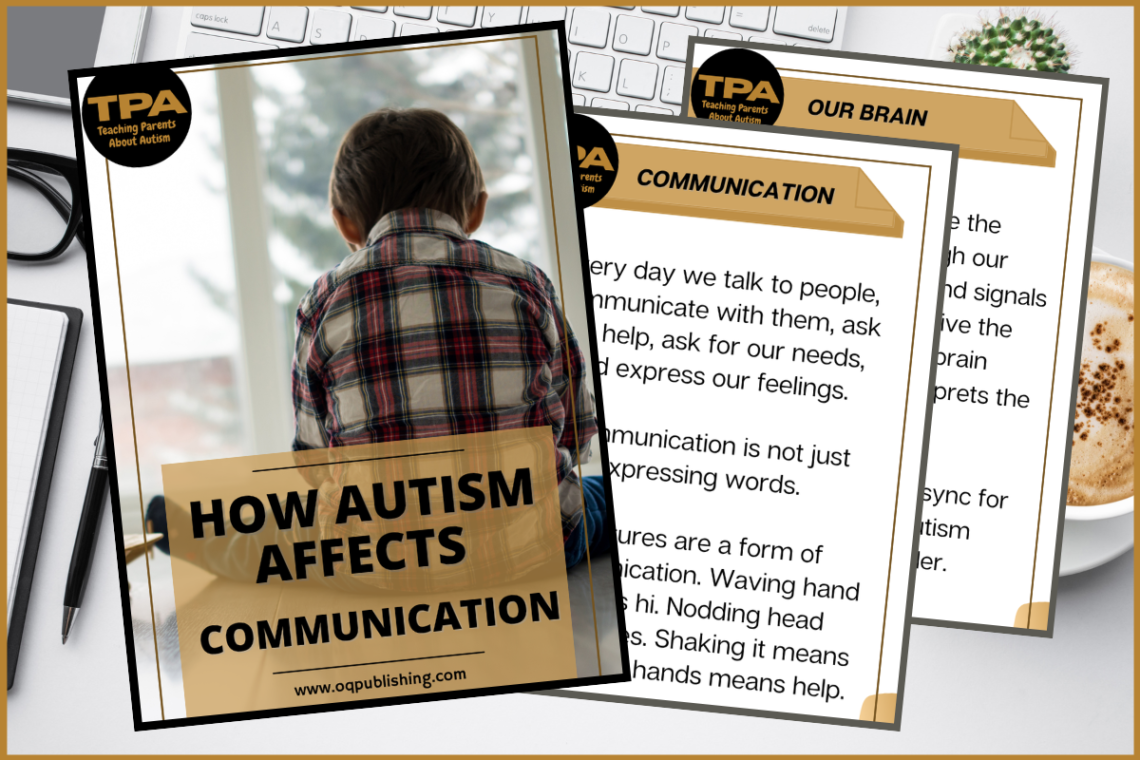
How Autism Affects Communication
Written By Quennie Lim
Autism affects many areas of a child’s life—and one of the most important is communication.
Every day, we communicate to connect with others. We ask for help, express our needs, and share our feelings. But communication is not just about words.
It also includes gestures, body language, facial expressions, and actions. Waving can mean “hi.” Nodding can mean “yes.” Shaking the head can mean “no.” Pulling someone’s hand can mean “help me.”
For children with autism, these forms of communication can be challenging.
What Happens in the Brain?
Communication involves many parts of the brain working together. The brain processes sounds, words, and meaning. The lips, tongue, vocal cords, and other oral muscles work together to produce speech. Nerves send signals to the brain so that speech and movement can happen in the right way.
For children with autism, this process may not always work smoothly or in sync. They may have difficulty understanding spoken language, forming words clearly, or coordinating speech and movement.
On top of that, they also need to learn many social communication skills such as taking turns in conversation, reading gestures, using their hands appropriately while talking, and understanding how other people communicate.
Receptive and Expressive Language
Communication is a two-way process.
- Receptive language is how a child understands spoken language.
- Expressive language is how a child uses words, gestures, or actions to express thoughts, needs, and feelings.
A child with autism may understand more than they can say, or they may have difficulty with both understanding and expressing language.
How Sensory Processing Affects Communication
Autism is a neurodevelopmental disability, which means it affects how the brain develops and functions. Many children with autism experience the world differently because of sensory processing challenges.
Imagine trying to listen and understand while there are many things happening at once: background noise, people talking, the television playing, a cluttered room, and other distractions.
For a child with autism, all of these inputs can feel overwhelming. This may lead to hyperactivity, inattention, frustration, dysregulation, or even a meltdown.
Because of this, communication is not always just about hearing words. It is also about how the brain receives, organizes, and understands information.
Many Children with Autism Are Visual Learners
Many children with autism think in pictures. Visuals are often one of their greatest strengths.
While spoken words disappear quickly, pictures stay in front of them longer and can make meaning clearer. A child may miss parts of long verbal instructions, but a clear visual can help them understand more accurately.
This is why using pictures, visual schedules, symbols, and simple visual supports can make communication much easier for children with autism.
Why Early Support Matters
A speech therapist is an expert in helping children build communication skills. Early intervention can support a child in improving speech, understanding language, using social communication, and expressing needs and emotions more effectively.
The earlier support begins, the more opportunities a child has to develop these important life skills.
What Parents Can Do
- Use pictures and visual supports when teaching.
- Keep instructions short and simple.
- Reduce background noise when speaking to your child.
- Give your child enough time to process information.
- Use gestures together with spoken words.
- Be patient and observe how your child communicates best.
Final Thought
Children with autism are not unwilling to communicate. Many of them simply communicate differently.
When we understand how autism affects communication, we become better prepared to support, teach, and connect with our children in meaningful ways.
Use visuals. Keep things simple. Be patient. Small changes can make a big difference.


You May Also Like
Is There Something Wrong If My Child Has Autism
Why Meltdowns Occur in Children with Autism